Mary Madison, RN, RAC-CT, CDP
Clinical Consultant – Briggs Healthcare

“Eighty-one percent of nursing facilities would need to hire additional staff to comply with new nursing staff requirements that the Centers for Medicare and Medicaid Services (CMS) proposed earlier this month, according to a new analysis from KFF. Under the proposed rule,19% of nursing facilities would currently meet the minimum staff hours for registered nurses and nurse aides.
A smaller share of for-profit facilities would meet the proposed staffing requirements. Compared to 60% of non-profit and government facilities, 90% of for-profit facilities would need to hire additional nursing staff. Four in five for-profit facilities would need to hire nurse aides in particular, compared to about half of non-profit and government facilities.
Current compliance with the proposed new standards also differs dramatically by state. In Alaska, 100% of nursing facilities would meet the HPRD staffing requirements, compared to just 1% of facilities in Louisiana. In 29 states, less than a quarter of nursing facilities could meet these requirements. In six states, over half of facilities could do so.
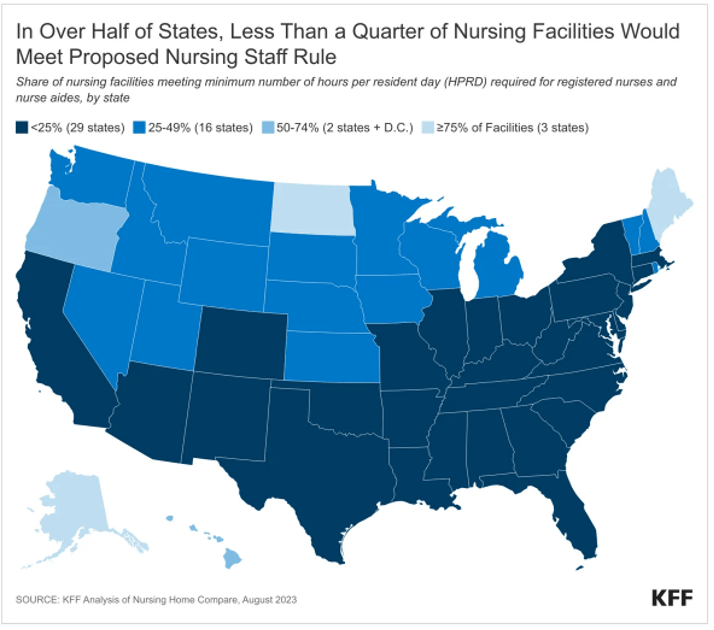
Broad workforce shortages, hardship exemptions, and issues with enforcement and funding could influence the final rule and also limit its impact. CMS’s proposed rule was released on September 1 and comments are due by November 6, 2023.
KFF’s analysis uses the most currently available data for both registered nurse and nurse aide hours from the Nursing Home Compare dataset, which includes 14,591 nursing facilities (97% of all facilities, serving 1.17 million or 98% of all residents) that reported their staffing levels in August 2023.”
The analysis was published on Monday, September 18, 2023.
Consider their suggested key-watch issues:
- Will broad workforce shortages in the LTSS sector and widespread hardship exemptions limit the effects of the new rule when implemented?
- How will CMS enforce the requirements and will the agency receive sufficient funding for the costs of verifying compliance?
- How will the costs of paying new staff will be financed?
- How will the provisions of the final rule compare to those of the proposed rule?
Read the entire analysis here. It is worth reading and sharing with colleagues.
I also encourage you to review the proposed rule and voice your concerns regarding this proposed rule. Now is the time to speak up!!

 BriggsNetNews